Everstorm
The Way of KingsEverstorm is a prophesied and seemingly unprecedented storm whose approach is repeatedly announced as a crisis beyond ordinary highstorms. Its decisive significance lies in the way it links natural violence, ancient supernatural history, and the threatened return of the Voidbringers: the warning that it comes is inseparable from the commands to prepare and unite. The book presents it first as an unseen future, then as a force whose approach can be sensed through visions, voices, and the trembling of the land.
Prophecy and Historical Threat
Everstorm enters the narrative as the culmination of a warning given to Dalinar Kholin during a vision. The booming instruction orders him to unite people, build a fortress of strength and peace, cease internal quarrels, and prepare because the Everstorm comes. The storm is therefore not merely weather; it is the reason offered for political unity and defensive preparation. Dalinar’s uncertainty about whether the vision comes from the Almighty makes the warning difficult to act upon, but its language gives the approaching disaster a clear strategic consequence: division is presented as a danger in itself.
The storm is also placed within a much older history. During Kaladin Stormblessed’s supernatural encounter with a voice that identifies him as a child of Tanavast, a child of Honor, and a child of one long since departed, the voice declares that the Oathpact was shattered. The declaration connects the coming danger to the collapse of an ancient defense against catastrophe. Everstorm thus stands at the intersection of remembered cosmic history and present-day events, while remaining only partially understood by those who hear its name.
Signs of Approach
The narrative distinguishes Everstorm from the recurring highstorms that structure daily life on Roshar. Highstorms can be predicted mathematically; Tvlakv nearly misses preparing for one because the relevant list of dates had been destroyed, while Kaladin Stormblessed knows that his father had made a hobby of calculating storm patterns and could choose the correct day eight times out of ten. Such knowledge allows people to plan for ordinary atmospheric danger, even when their shelters are poor and their circumstances precarious. Everstorm is different because the warnings surrounding it describe an approaching historical rupture rather than a regular, calculable cycle.
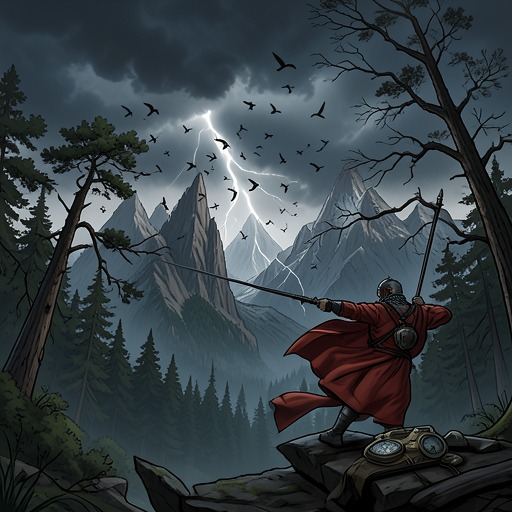
Its approach is repeatedly rendered through physical and visionary disturbance. When Dalinar Kholin and Renarin Kholin reach the Kholin warcamp, Renarin points east toward a stormwall hanging like a curtain, its rain silver-gray beneath onyx-black clouds lit by lightning. The immediate scene concerns survival before a storm, but the image also echoes the larger prophecy: a wall of weather advances toward a society already under military strain, and even a fortified camp offers only a brief interval before impact.
The most extreme sign appears in Dalinar Kholin’s vision when the land begins to tremble and a wall of dust advances. The approaching force is not initially explained; the ground falls away, rocks shatter into dust, and an earthquake is accompanied by the roar of dying stone. This image expands the meaning of storm from atmospheric movement to planetary upheaval. The threat is first perceived as something approaching from beyond sight, and only then disclosed through the destruction it causes.
The Everstorm and the True Desolation
In a later vision, the voice states that the Everstorm comes alongside the True Desolation and the Night of Sorrows. The three terms form a chain of impending consequences rather than isolated predictions. Everstorm is the visible or environmental sign, the True Desolation names the larger return of apocalyptic conflict, and the Night of Sorrows marks another dimension of catastrophe. The repeated command to unite gives the prophecy a practical response, but the sequence also shows how little control the characters possess over the forces being announced.
The storm’s relationship to the Parshendi further complicates its significance. Their communities on the edge of the Shattered Plains are built from crem and stone in craterlike formations, and they respond to the possibility of buildings being blown down with the assurance that the structures can simply be rebuilt. Their apparent acceptance of repeated destruction contrasts with the fear shown by enslaved people during violent highstorms, when they huddle together and associate the most dangerous storms with the Stormfather, the shades of the Lost Radiants, or the Voidbringers. Against this background, Everstorm threatens not only to intensify physical destruction but also to expose the limits of the practices and beliefs developed to survive ordinary storms.
Narrative Function and Significance
Everstorm is narrated through delay, repetition, and incomplete revelation. Its name appears in warnings before the event itself is fully understood, so anticipation precedes direct knowledge. Each recurrence adds a different dimension: Dalinar Kholin receives the political imperative to unite; Kaladin Stormblessed hears that the Oathpact was shattered; later vision-language places the storm beside the True Desolation and the Night of Sorrows; and the trembling landscape gives the prophecy material force. The repeated announcement does not make the threat familiar. Instead, it makes every new sign feel like confirmation of a danger whose scale remains beyond the characters’ grasp.
The contrast between ordinary highstorm preparation and Everstorm’s prophetic status is central to the concept. Mathematics, schedules, wagons, shelters, and bunkers can mitigate a recurring storm, but none of these practical measures answers a force tied to broken ancient covenants and the possible return of the Voidbringers. Everstorm therefore functions both as an environmental catastrophe and as a test of collective organization. The command to unite is not decorative prophecy: it is the narrative’s explicit answer to a disaster that turns private survival into a question of whether societies can act together before the storm arrives.